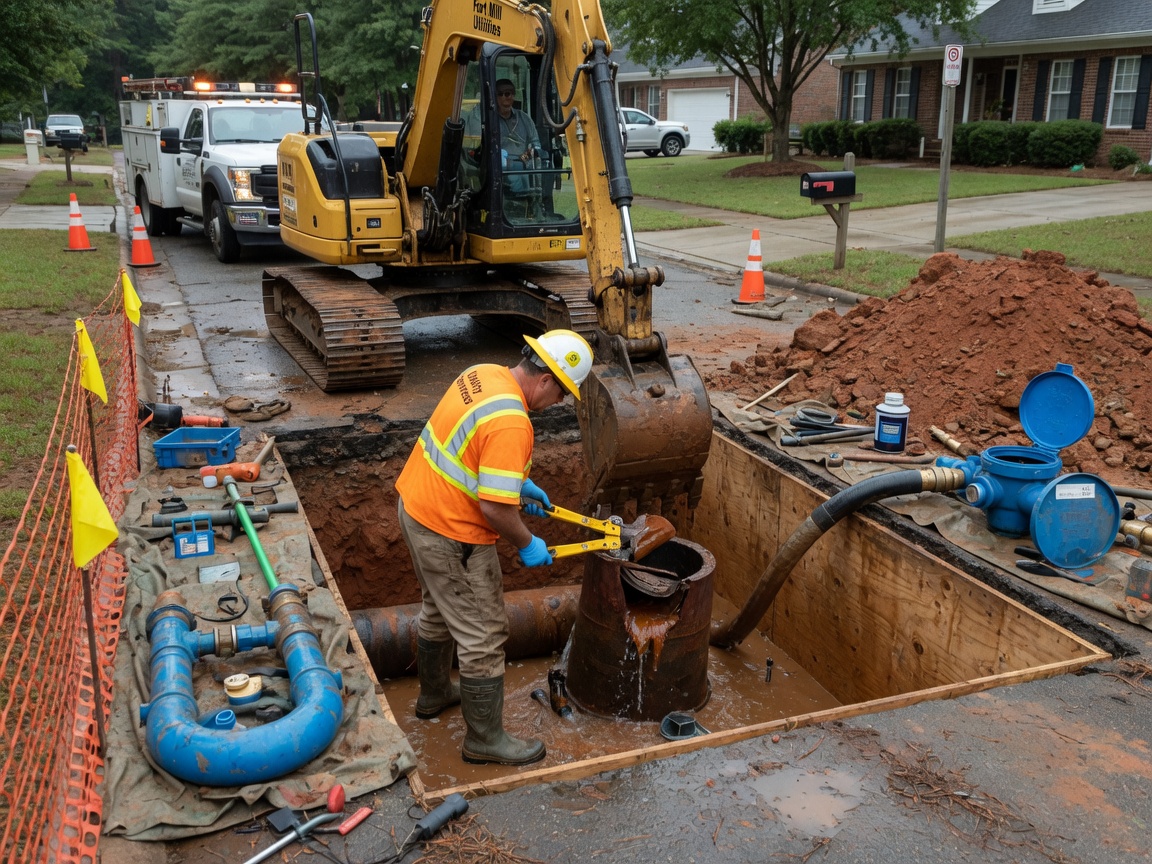
In Fort Mill homes built before the 1990s near the Fort Mill History Museum or along Anne Springs Close Greenway, galvanized and cast iron main lines commonly corrode from the inside out. Humid subtropical weather keeps soil moisture high year-round, accelerating rust and creating pinhole leaks that migrate under slabs. Mild winters reduce freeze risk but allow constant ground movement from expansive clay soils in York County, stressing joints where lines enter the foundation.
Trenchless pipe bursting or lining works well on straight runs from the meter to the slab edge in Springfield neighborhoods, but older Baxter Village properties often require hybrid excavation when lines take sharp turns around mature landscaping or septic fields. Charlotte and Rock Hill utilities enforce specific backflow and pressure requirements that affect how we restore service after a repair, especially on lots with steep drainage toward the greenway.
Homeowners frequently discover main line issues only after a slab leak appears because the same soil conditions that shift foundations also move exterior piping. We always pressure test the full run from the street valve through the foundation penetration before backfilling to catch secondary failures that would otherwise require reopening the trench weeks later.
Technician insight
In Fort Mill the thing that catches most people out with Main Water Line Repair is how the same clay-heavy soils around Springfield that cause slab movement also push exterior mains out of alignment at the foundation penetration, so a leak you think is just under the slab is often six feet outside the house.
Springfield Main Line Shift
A homeowner in Springfield noticed low pressure and damp soil near the front walk. Camera inspection showed the galvanized main had pulled away from the slab entry due to seasonal soil movement. We replaced the exterior section with HDPE using a small trench along the driveway edge, pressure tested the full line, and restored the yard the same afternoon.
Main Water Line Repair Services We Offer
✓Trenchless Main Line Replacement
Pipe bursting or lining replaces failing galvanized lines without destroying driveways in Baxter Village and Springfield yards.
✓Main Water Line Leak Detection
Electronic and camera inspection locates leaks under slabs before excavation begins on York County properties.
✓Foundation Penetration Repair
Seals and replaces corroded pipe where the main enters the slab, common in pre-1980 Fort Mill homes near the History Museum.
✓Meter to House Line Repair
Repairs the exterior run from the meter to the foundation using minimal digging suited to humid clay soils.
✓Emergency Main Shutoff Service
Rapid isolation and temporary bypass for catastrophic main line breaks affecting Rock Hill and Charlotte commuters.
Main Water Line Repair Cost in Fort Mill, SC
| Service | Typical Range | What Affects It |
|---|---|---|
| Trenchless Line Replacement | $2,400–$4,800 | Longer runs past mature trees or near the greenway increase cost |
| Limited Excavation Repair | $1,600–$3,100 | Access through yard rather than driveway keeps price lower |
| Foundation Penetration Fix | $850–$1,650 | Includes sleeve and waterproofing on older slabs |
| Full Camera + Pressure Test | $275–$425 | Required before any repair to confirm scope |
Ranges are typical for Fort Mill, SC and confirmed with an exact written quote before any work starts.
How it works
- 1
Site Assessment
We map the line from the meter through the slab edge using camera and electronic locating while checking soil moisture around Baxter Village and Springfield lots.
- 2
Access Planning
Trenchless or limited-dig methods are selected based on tree roots, driveways, and proximity to the Anne Springs Close Greenway drainage.
- 3
Repair Execution
New HDPE or copper line is installed, pressure tested to York County standards, and tied back into the existing interior piping.
- 4
Restoration And Testing
Backfill is compacted in layers, sod replaced, and the full system is monitored for 24 hours before final sign-off.
Pricing
Most Fort Mill main line repairs fall between $1,800 and $4,200 depending on length, depth, and whether trenchless methods apply.