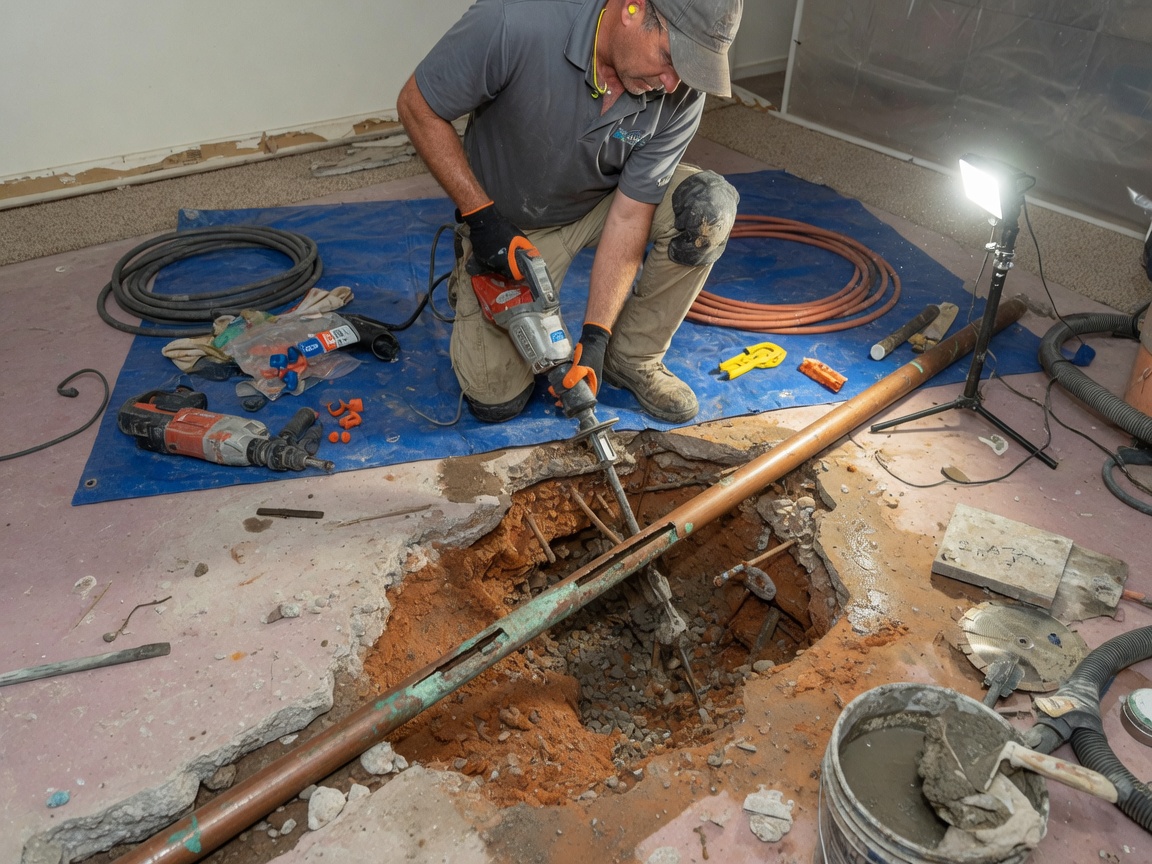
Homes in Baxter Village and Springfield often sit on expansive clay soils common across York County. These soils swell and contract with the region's humid subtropical rains, stressing older copper or galvanized lines that run under slabs. Mild winters reduce freeze risk but increase year-round moisture that accelerates corrosion at joints. Slab leak repair here requires electronic listening devices and camera scoping before any concrete is opened, because random jackhammering quickly turns a contained leak into a major floor replacement job.
Access points are chosen based on the home's original plumbing layout rather than the shortest path. In neighborhoods near the Fort Mill History Museum, many slabs were poured over pipes installed before modern sleeving standards, so plumbers must trace lines from the meter through the foundation edge. Once the break is isolated, options include sectional replacement or epoxy lining depending on pipe material and remaining length. Homeowners in Rock Hill and Charlotte who skip scoping often discover multiple leaks once the first repair is complete.
Terrain near the Anne Springs Close Greenway creates drainage patterns that funnel water toward foundations during heavy summer storms. This constant saturation keeps slab temperatures lower and promotes condensation on pipes, masking the true source of moisture. Repair crews account for this by pressure testing the entire run after the initial fix and documenting flow rates before backfilling. Proper compaction of the sub-slab material prevents future settling that can re-crack patched concrete.
Technician insight
In Fort Mill, the thing that catches most people out with Broken Pipe Under Slab Repair is how the clay soils around Baxter Village and Springfield keep shifting after every heavy rain. Homeowners often think one small wet spot means a single leak, but the movement has usually stressed several joints along the same run.
Springfield Home Moisture Issue
A homeowner in Springfield noticed warm floors and rising water bills after summer storms. Scoping revealed a corroded copper joint under the living room slab. The crew made one access cut, replaced the section, pressure tested the line, and patched the concrete in a single day.
Broken Pipe Under Slab Repair Services We Offer
✓Electronic Leak Detection
Non-invasive listening and camera equipment locates the exact break point beneath the slab without unnecessary demolition.
✓Sectional Pipe Replacement
Targeted removal and replacement of the damaged pipe section through minimal access points cut in the slab.
✓Epoxy Pipe Lining
Interior coating applied to restore older lines when full excavation would disturb finished flooring.
✓Slab Access and Restoration
Precision cutting, debris removal, and concrete patching matched to the existing floor finish.
✓Post-Repair Pressure Testing
Full-system pressure check confirms the repair holds before the slab is closed and finished.
Broken Pipe Under Slab Repair Cost in Fort Mill, SC
| Service | Typical Range | What Affects It |
|---|---|---|
| Electronic Detection Only | $250–$450 | When no excavation is required |
| Single Section Replacement | $1,400–$2,600 | Includes one access cut and patch |
| Epoxy Lining (10–20 ft) | $1,800–$3,200 | Depends on pipe diameter and access |
| Additional Access Cut | $350–$650 | Per extra opening needed |
Ranges are typical for Fort Mill, SC and confirmed with an exact written quote before any work starts.
How it works
- 1
Initial Assessment
Technician reviews water usage history and performs electronic listening at multiple points around the slab.
- 2
Precise Location
Camera scoping and pressure isolation pinpoint the break while mapping nearby utilities.
- 3
Targeted Access
Small openings are cut only where needed to reach the damaged section.
- 4
Repair And Test
Pipe is replaced or lined, then the system is pressure tested before concrete restoration.
Pricing
Most broken pipe under slab repairs in Fort Mill fall between $1,200 and $3,800 depending on access difficulty and pipe material.